
TOP 10 Advantages of Retrofitting in Industry: A Smart Shift Towards Sustainable Growth

Whether you are in manufacturing, energy, or infrastructure, the advantages of retrofitting in these industries are significant, ranging from cost savings and increased energy efficiency to extended equipment life and compliance with modern standards. In today’s fast-paced industrial environment, organisations constantly face the challenge of balancing performance, efficiency, and sustainability. One strategic solution that has emerged as a cost-effective and eco-friendly approach is retrofitting. Saving money, prolonging the life of equipment, and adhering to contemporary regulations are the main advantages of retrofitting.
What Is Retrofitting in Industry?
Retrofitting is the process of adding new technologies or features to old machines or systems to enhance their performance or functionality. Retrofitting enables industrial assets to function more efficiently and last longer than if they were replaced.
Here are some common examples of retrofitting:
- Transitioning from relay logic to PLCs enhances control systems.
- Putting in motors and lights that use less energy.
- Adding IoT sensors for predictive maintenance.
- Updating HVAC systems.
- Improving safety measures to meet current rules.
Advantages of Retrofitting in Industry
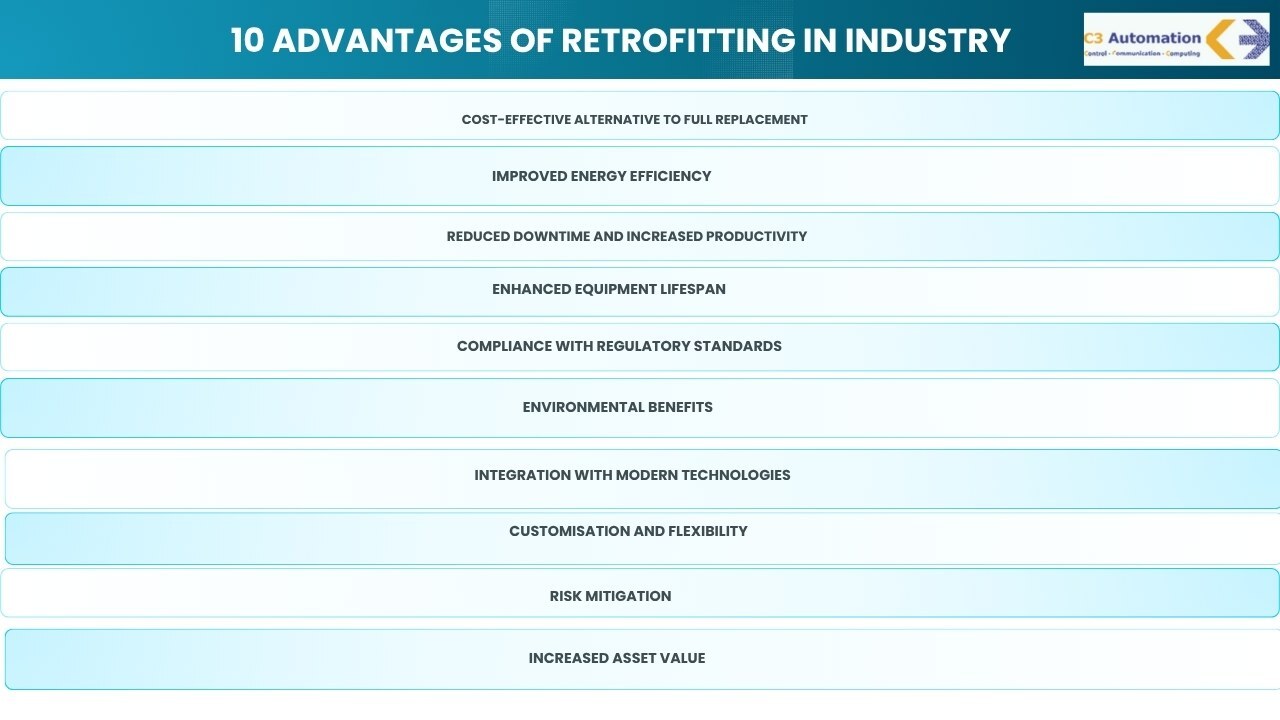
Let’s examine some of the primary advantages of retrofitting, which demonstrate why an increasing number of businesses prioritising sustainability and long-term profitability are opting for it.
1. A less expensive choice than replacing everything
One of the advantages of retrofitting is that it saves money. Replacing machinery or infrastructure completely means spending a lot of money, a lot of time, and a lot of operating downtime.
– Less money needs to be spent on capital
– Installation time is kept to a minimum
– Phased upgrades can be prioritised
Example: Instead of replacing an entire production line, a manufacturing unit can improve output and lower downtime by updating individual motors and controllers on machines.
2. Enhanced Energy Efficiency
Older equipment requires more energy to operate, which raises the cost of operating a business. Retrofitting old machinery improves performance by replacing malfunctioning motors.
It lets businesses:
– Use VFDs (Variable Frequency Drives) to make the most of energy use. – Replace old motors with high-impact rated IE3 or IE4 motors.
– Change to LED lights – Use smart retrofitting energy monitoring tools.
These efforts can lower electricity use by 20% to 40%, which can save a lot of money in the long run.
3. Less downtime with more efficiency and productivity
In an industry, operations can’t be stopped for long periods or forever. One of the main strategic advantages of retrofitting is that it can be done without major delays to normal business operations. Focusing on certain parts instead of full systems keeps downtime to a minimum. Also, newer parts come with built-in diagnostics and remote monitoring, which lets operators:
- Finding problems early
- Improving maintenance schedules
- Make machines work more often and more efficiently.
4. Longer life for equipment
Machinery costs a lot of money, so it’s important to make it last as long as possible. Adding new parts to old systems makes them work better. For example, you can improve the precision of older servo-hydraulic systems by adding newer modular servo-hydraulic controllers.
- Newer PLCs can be used on older production lines to make them easier to control and integrate.
- This not only increases the return on investment (ROI), but it also makes assets last longer.
5. Following the Law
Most firms work inside a system of safety and environmental rules that is always changing. Not following the rules could involve fines, stops in operations, or damage to your reputation integrating:
- New safety features like sensors, alarms, and interlocks
- New standards for emissions or energy efficiency.
- Better safety and comfort at work.
Retrofitting is a faster and cheaper option to fulfil compliance than building systems from the ground up.
6. Good for the environment
The strategy of retrofitting is good for the environment. It follows the concepts of the circular economy by using equipment that is already there instead of needing new resources. The following benefits are gained:
- Less waste from items that were made
- Less carbon footprint because of less manufacturing and transportation
- Less pollution because of operations that use less energy
Companies that care about ESG goals generally include retrofitting in their plans for being more environmentally friendly.
7. Working with new technologies
The fourth industrial revolution’s digital change makes retrofitting necessary. It lets you turn traditional systems into smart systems by using new technologies like:
- Sensors for the Internet of Things (IoT)
- SCADA and HMI user interfaces
- Tools for predictive maintenance
- Analytics on the cloud
- Monitoring and controlling from afar
All of these tools let businesses collect data in real time, improve their processes, and make decisions based on data at the infrastructure level without having to completely change their systems.
8. Personalisation and adaptability
Retrofitting allows businesses to select upgrades that suit their specific needs, goals and budget.
Example:
- A packaging company could want to focus on quickly retrofitting conveyor systems.
- A chemical plant might improve safety procedures that are meant to protect workers from toxic products and put safety first.
This way of modernising is modular, which makes it more flexible and scalable than replacing everything at once.
9. Reducing risk
When replacing big pieces of industrial equipment, there is always a chance that the following will happen:
- Problems in meeting deadlines
- Issues in adding new systems to old ones
- Demands for retraining employees
Retrofitting helps improve performance while keeping the system familiar by lowering these dangers. Employees may keep using the systems with only a little training, and organisations don’t have to deal with a lot of downtime during the commissioning phases.
10. Higher Value of Assets
Retrofitting systems gives you better performance, more safety, better energy efficiency, and more value overall. Retrofitting systems not only makes things work better and improves performance, but it also raises the value of the assets. In real estate, rehabilitated buildings rent for more and sell for more since they meet higher current efficiency standards and have more amenities.
Example from the real world: retrofitting in manufacturing
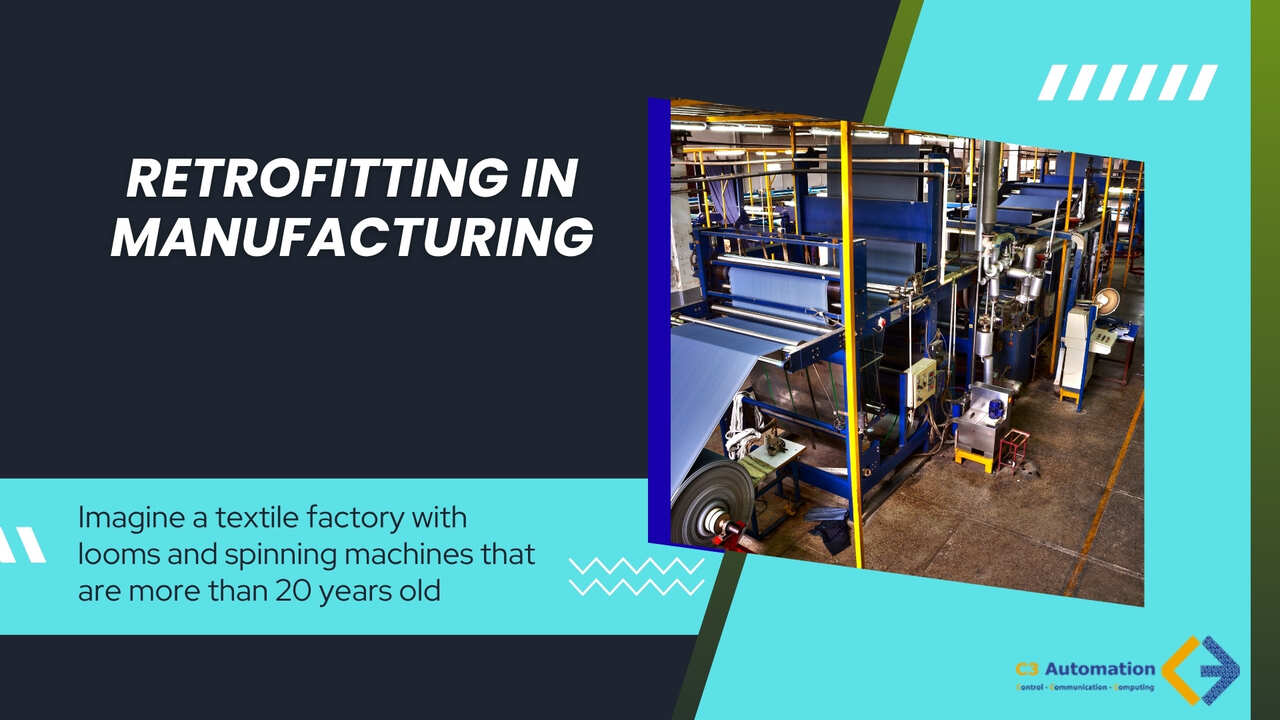
Imagine a textile factory with looms and spinning machines that are more than 20 years old. The company decided to refit instead of rebuilding the entire line, using IE4 motors that consume less energy as an alternative. PLC-based automated control systems are replacing manual controllers. New emergency stop systems are replacing safety guards.
Results that were reached include:
- 30% less power used
- The efficiency of production went up by 15%.
- Following safety rules for workers
- Investment recovery in 18 months
Things to think about while retrofitting
Retrofitting, like any other method, has its downsides:
- Some legacy equipment compatibility problems could make retrofitting harder.
- During retrofitting, equipment may cause short-term problems.
- Even if the initial cost of retrofitting is lower than that of replacing, it is still high.
Even with these problems, good preparation and getting advice from experts can help with most of them.
Conclusion
The advantages of retrofitting in industry go far beyond cost savings. From enhancing energy efficiency and productivity to supporting sustainability and regulatory compliance, retrofit is a smart and strategic move for industries seeking to thrive in a competitive and evolving marketplace. Instead of investing in entirely new systems, retrofitting offers a sustainable and efficient path to modernisation — one that respects both your bottom line and the planet.
FAQ
1.What does retrofitting mean for the industrial segment?
In the industrial domain, retrofitting is the process of changing and improving old worn-out industrial machinery parts, which improves their efficiency, safety, performance, or compliance with modern-day regulations to mitigate changing the systems already in place.
2.What are the advantages of retrofitting in a particular industry?
In industries where retrofitting processes are applied, advantages include, but are not limited to, controlling cost, reclaimed productivity and efficiency, reduced maintenance and downtime, improved safety, new compliance requirements, and becoming part of the revolution (Industry 4.0) technology advancing.
3.Under what circumstances should a company consider retrofitting rather than replacing equipment?
A company seeking to retrofit equipment should ensure that the equipment is functioning, though outmoded, energy expenses are exorbitant, procuring supplemental components poses challenges, or there is a need to comply with new safety or environmental regulations, which necessitates a retrofit rather than a redundant major capital investment.
4.How does retrofitting help save energy?
Retrofitting saves energy by replacing old equipment with newer, more efficient components, such as motors, variable frequency drives (VFDs), LEDs, and smart lighting. These can cut electricity use by 20–40% and save money over time. This process also has benefits for long-term cost savings.
5.Can retrofit strategies help industrial sectors meet compliance standards in a useful way?
Yes. Retrofitting helps businesses move from old systems to new ones that meet modern safety, environmental, and operational standards. This can help them avoid fines or shutdowns for not following the rules.