
PLC vs DCS 2026: The Complete Engineering Guide to Industrial Control Systems
Ask ten automation engineers whether a project needs a PLC or a DCS and opinions will vary fast. Get it wrong, and a plant either pays for capability it never touches or builds something too thin to scale past year two. This guide walks through PLC vs DCS architecture, performance and cost so the decision comes down to facts rather than habit.
It’s easy to underestimate how far this choice reaches. Wiring layout, panel design, and maintenance budgets for the next decade all trace back to whichever architecture gets picked on day one, before a single plc panel shows up on site. Plant managers, controls engineers, and plc system integrators each walk in with different priorities — execution speed, plant-wide visibility through scada or simply keeping the budget sane. Get the architecture right early and expanding I/O or growing the industrial automation footprint later becomes routine, not a headache.
PLC vs DCS: Breaking Down the Key Differences
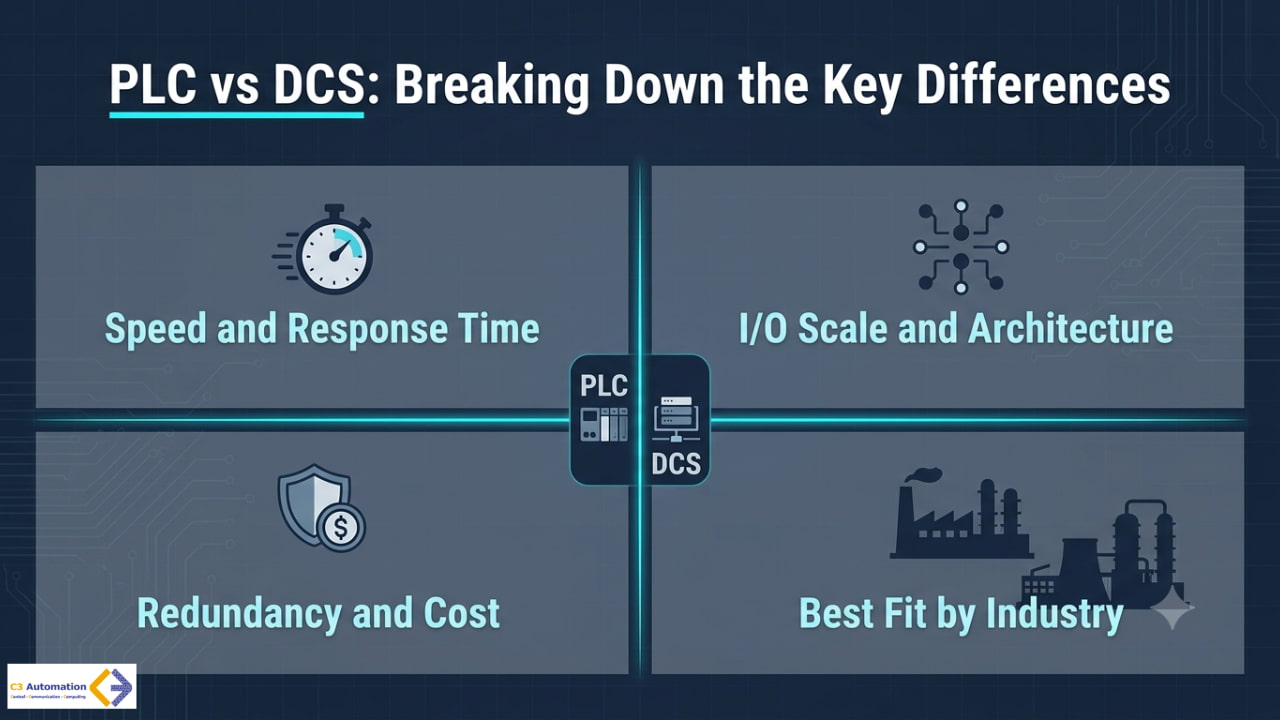
Before getting into the weeds, here’s the short version for teams sizing up PLC vs DCS options on a new or growing facility.
Speed and Response Time
A plc is built to be fast and predictable — scan times land in the 1–10 millisecond range, exactly what fast discrete machinery needs. A DCS trades that speed for breadth, running on a 100–500 millisecond cycle while juggling heavier, continuous loop math across a wider footprint. That gap is usually why industrial automation teams reach for a plc on rapid switching or motion control.
I/O Scale and Architecture
Somewhere around 2,000 I/O points, a plc-only approach starts fighting itself — wiring, tagging and inter-controller messaging start costing more than the modular plc panel setup saves. A DCS avoids that wall, built from the ground up to run thousands of I/O points through one centralized, plant-wide database instead of scattered standalone controllers. Facilities expecting real growth tend to weigh this factor hardest of all.
Redundancy and Cost
Most plc deployments treat redundancy as an add-on. A DCS doesn’t give you that choice — built-in hardware and software redundancy comes standard. That difference shows up directly in the price tag: a plc-based system is cheaper up front, while a DCS asks for more capital early in exchange for operating costs that stay predictable for years.
Best Fit by Industry
Packaging lines, bottling plants, and standalone equipment skids are plc territory, where speed and simplicity beat plant-wide coordination. Refineries, water treatment, and power generation lean toward DCS instead, since thousands of interdependent control loops need to run without a single blind spot. Most plc system integrators can spot which category a facility falls into within the first site visit.
What Is a PLC? The Workhorse of Industrial Automation
A PLC — a programmable logic controller — is a microprocessor-based industrial computer built to run the same control logic over and over with microsecond precision. Crack open any plc panel and you’ll find input/output modules, a CPU, and communication ports wired straight into sensors, actuators, and drives on the floor. Because a plc is compact, it slots into a single machine or networks across a production line without the overhead of a full plant-wide system.
Core Hardware and Software Capabilities
Modern PLCs pair standalone control with fieldbus connectivity, running fine alone or as part of a larger industrial automation network. Hardware options range from small all-in-one units to rack-based modular systems that grow with I/O count.
Ladder Logic Programming Explained
Ladder logic programming is still the go-to method for programming a plc, mostly because it looks like the relay schematics electricians already know how to read. Rungs of contacts and coils map directly onto real inputs and outputs, so troubleshooting a live plc panel on the shop floor is really just reading the same logic that built it. Structured text and function block diagrams have picked up ground for heavier math, but ladder logic programming still runs the show in discrete manufacturing since it’s transparent and easy to force live during commissioning. An engineer comfortable with ladder logic programming can usually hop between vendor platforms with only minor syntax hiccups.
Best Use Cases for PLC Deployment
These jobs call for millisecond scan times and direct wiring to field devices — nothing like the layered database a DCS runs on. A single plc can replace what once took a rack of relays and a networked group of PLCs can coordinate a production cell while reporting up to a central scada layer.
What Is a DCS? Plant-Wide Process Control at Scale
A distributed control system takes the opposite approach: one centralized architecture managing thousands of I/O points across continuous operations like oil and gas processing, refining and municipal water treatment. Where a plc-based setup runs on scattered logic, a DCS runs on a single shared database, so every controller and HMI faceplate pulls from the same real-time source.
Architecture, Redundancy and Safety Standards
A continuous process doesn’t get to go down, which is why built-in redundancy is baked into DCS design rather than offered as an option. Controllers, power supplies, and network paths are typically duplicated for automatic failover, often built to hit SIL-2 or SIL-3 under IEC 61511 and IEC 61508. Pair that with native batch management under ISA-88, and it’s easy to see why large plants default to DCS over stitching together dozens of independent PLCs.
Best Use Cases for DCS Deployment
Anywhere thousands of sensors and control loops need real-time coordination without gaps, a DCS earns its keep — handling heavy loop processing and round-the-clock alarm management. It also doubles as an edge engine, feeding live production data into broader OT-IT networks for compliance and performance tracking.
Difference Between PLC and DCS: Core Architectural Contrasts
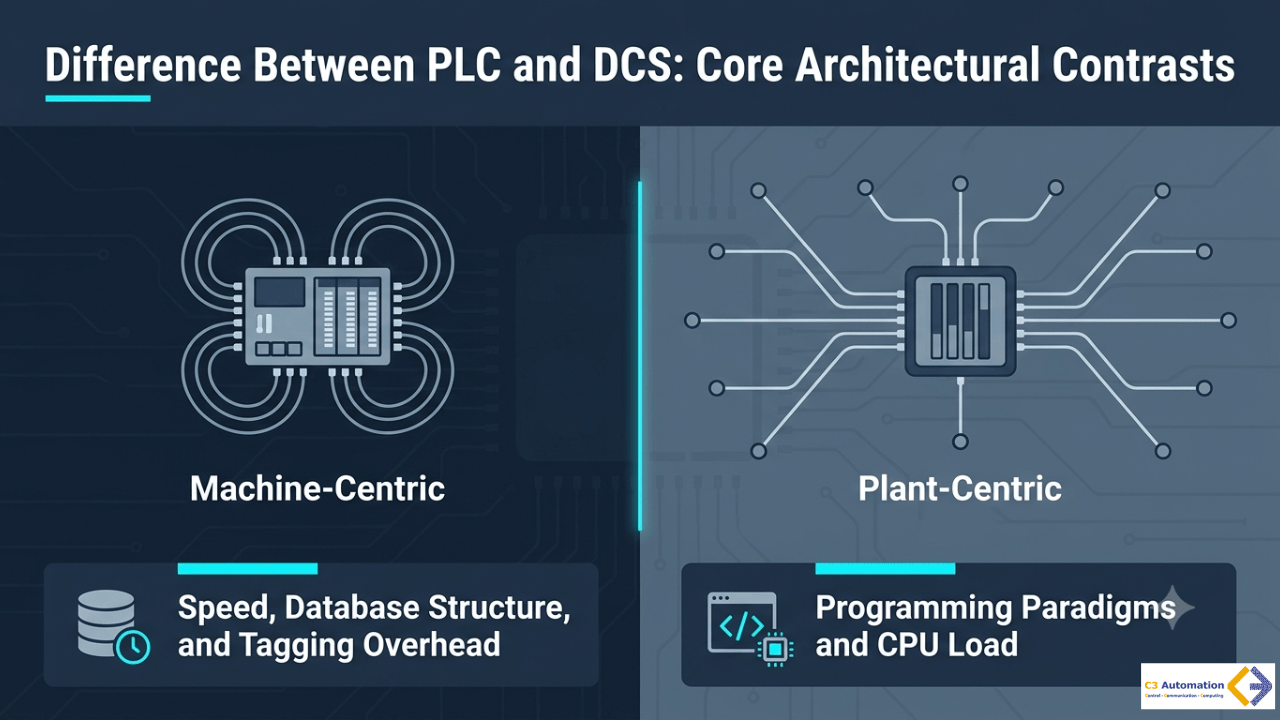
The real difference between PLC and DCS comes down to one being machine-centric, the other plant-centric. A PLC handles standalone or modular control of a specific machine; a DCS is built from day one to unify control across an entire facility. That distinction ripples down to how engineers approach industrial plc programming versus DCS configuration.
Speed, Database Structure and Tagging Overhead
Speed isn’t the only place these two part ways — database structure diverges too. A DCS resolves tags natively through point.block.parameter addressing across one shared database, while a networked group of PLCs usually needs manual array packing to get the same visibility. Ask any engineer managing over a thousand routines in a sprawling plc-only setup, and this tagging overhead is probably the first complaint.
Programming Paradigms and CPU Load
Industrial plc programming leans on lightweight, fast languages — ladder logic and structured text under IEC 61131-3 — keeping CPU overhead low for interlocks that can’t afford to lag. DCS platforms often run higher-level languages like Continuous Function Chart, which compile into heavier loads better suited to loop control than split-second discrete switching. A difference between PLC and DCS debate usually comes back to matching CPU architecture to actual timing needs.
Ladder Logic Programming and the Hybrid Architecture Trend
The clean line between a pure plc and a full DCS keeps getting blurrier. Modern Programmable Automation Controllers borrow from both worlds — running ladder logic programming for fast, machine-level tasks while plugging into a centralized SCADA or DCS backbone for plant-wide visibility. In this tiered setup, a DCS or high-end PAC plays the “brain,” while dedicated PLCs handle specialist work like OEM package equipment and compressors.
Next-Generation Connectivity and Cybersecurity
Ethernet-APL now brings high-speed digital communication to hazardous field instruments once stuck on slow analog signals, while OPC UA and MQTT are becoming the default protocols for tying IIoT data together across plc and DCS environments alike. On security, the old “air-gap will save us” mindset is giving way to IEC 62443-compliant segmentation and secure remote access, since more plc panel and DCS hardware than ever sits on a network.
PLC vs DCS vs SCADA: Clearing Up the Confusion
PLC vs DCS
The PLC vs DCS comparison is where most of the confusion starts. A PLC is built for fast, discrete logic on a single machine or production cell — sequencing, interlocks, batch control. A DCS is architected around continuous process control spread across many loops, tied together by a shared database and control philosophy meant to scale across an entire facility.
Where SCADA Fits In
People mix these up constantly: SCADA sits above the control hardware, not underneath it. SCADA is a supervisory and visualization layer pulling data from PLCs or DCS controllers to show trends and alarms — it doesn’t touch direct control at the field level. Safety Instrumented Systems sit apart, kept physically and logically isolated from PLC and DCS logic under IEC 61511 and IEC 61508.
Total Cost of Ownership: CapEx vs Long-Term OpEx
CapEx vs Long-Term OpEx
Lower upfront cost is the main reason facilities gravitate toward PLCs, but those savings can evaporate over a twenty-year lifecycle if engineering sprawl creeps in. Keep adding independently programmed PLCs and maintenance hours eventually outpace what a single unified DCS database would cost to run. A DCS costs more on day one but holds operating costs steady long-term, especially once downtime starts getting measured in lost production. Experienced PLC system integrators push for a full TCO comparison before anyone signs off on architecture.
Choosing the Right System: A Practical Decision Framework
Key Questions Before Choosing
Four questions do most of the work: Is this discrete logic or continuous loop control? How many I/O points, and how spread out are they? How much does built-in redundancy matter here? And what expansion or IIoT plans are already on the roadmap? Walking through these with experienced PLC system integrators, backed by a site visit, usually steers clear of both DCS over-engineering and unplanned PLC sprawl.
Ladder Logic Programming
Most PLC-based control still runs on ladder logic programming. It mirrors the relay-based electrical schematics that plant electricians already read fluently, so troubleshooting on the floor doesn’t require a software specialist. It suits the discrete, rung-by-rung logic PLCs are built for, but becomes harder to manage as scope grows toward continuous, multi-loop process control — often the point where facilities start evaluating DCS or hybrid setups instead.
Still not sure whether a PLC, DCS, or hybrid setup fits the next project? A technical site evaluation can map out process requirements before a single panel gets ordered.
Conclusion
There’s no clean winner in the PLC vs DCS debate — just the architecture that matches a process’s speed, scale, and uptime demands. A plc remains the right call for fast, discrete equipment, and a DCS earns its higher price tag on large, continuous operations where thousands of I/O points and built-in redundancy aren’t negotiable. For many facilities, the real answer is a hybrid: ladder logic programming at the machine level, paired with a centralized DCS or SCADA backbone. Working through the difference between PLC and DCS with an experienced industrial automation partner before ordering hardware is the surest way to avoid both extremes.
FAQ
1. Is a PLC cheaper than a DCS?
Generally yes for upfront cost, especially on smaller or single-machine applications. However, total cost of ownership over a plant’s lifetime can shift the balance, particularly when multiple controllers must be networked and maintained.
2. Can a PLC and DCS work together in the same facility?
Yes. Hybrid architectures are increasingly common, with PLCs handling fast, localized machine control while a DCS or PAC coordinates plant-wide process data and safety systems.
3. What is the main difference between PLC and DCS response times?
PLCs typically execute in 1–10 millisecond cycles for discrete control, while DCS platforms operate on 100–500 millisecond cycles suited to slower continuous processes.
4. Do I need to know ladder logic to work with a DCS?
Not necessarily. DCS platforms often use higher-level languages like Continuous Function Chart, though many engineers with a ladder logic background transition smoothly given the shared underlying control logic concepts.
5. How do I know if my process needs redundancy?
If unplanned downtime results in significant safety risk, environmental impact, or production loss, built-in redundancy — standard in most DCS platforms — is generally worth the added investment.