
ERP System Integration: Boost Your Business Efficiency Today With C3 Automation
“ Does your company have a problem managing multiple systems? “Maybe it’s time you thought of integrating an ERP system.”
Simply put, businesses operate in a technology-driven ecosystem, where software applications for finance, payroll, supply chain, and even customer relations have dedicated applications. While these tools provide multiple services, they often create separate, unconnected data silos which block insights across the organization and create strategic inefficiencies. Integrating ERP (Enterprise Resource Planning) systems merges separate systems into one integrated software solution. Subsequently, seamless data transfer and extraction across functions are enabled, creating a unified view of business processes, aiding effective decision-making.
What is ERP System Integration?
ERP system integration means linking ERP application software with complementary or third-party applications and corresponding data stores to achieve instantaneous data access and update. As a result, business processes become more efficient as collaboration is enhanced, allowing for better overall performance. Whether it’s integrating with Customer Relationship Management (CRM) systems or proprietary e-commerce sites, ERP integration aligns all pieces, including older systems, to work towards better business achievement strategically.
Integrating the ERP systems is important for optimizing operations, lowering costs, and developing the business further. By consolidating information and automating workflows, all organizational activities become more flexible, and decisions are made with greater reliability, which helps stand out in the hypercompetitive digital business world.
Why ERP System Integration Matters

- Enhanced Automation and Productivity: With automation of processes brought through ERP system integration, the requirement for human monitoring and control is completely removed, improving error rates, productivity, and efficiency. Improved processes help both the delivery and the use of resources by businesses.
- Insights on Business Performance: ERP systems provide real-time analytics with system integrated modules, enabling timely data-driven decisions. Businesses with current information are able to adapt quickly to changes in the market and respond to buyers’ needs effectively.
- Unified Data Management: ERP systems integrate data across departments, enhancing visibility and control over organizational functions. Centralized control removes data silos enabling uniformity of information across organizational silos.
- Improved Communication: The availability of enterprise ERP platforms enhances departmental communication and collaboration towards the achievement of organizational objectives. Integrated systems encourage interdepartmental coordination and transparency, which improves overall performance.
Key Benefits of ERP System Integration
- Better Data Quality: With the integration of modules, most duplicates and inconsistencies of data are removed. This uniformity improves data quality throughout the organization, which minimizes mistakes and optimizes decisions.
- Reduced Costs: Automation drives process efficiency while appropriate resource allocation leads to improved cost savings. ERP systems highlight inefficiencies and areas that need improvement, which impacts overall expenditure reduction.
- Easily Adjustable: Your business will benefit from the use of a modern ERP system as it is flexible and adapts effortlessly to the advancements and changes that happen within your company. As your business grows, ERP systems can change alongside added needs and challenges.
- Regulatory Compliance: Integrated systems help businesses stay compliant with industry regulations by having proper reporting capabilities. ERP systems assist companies with legally complying with the changing business laws and standards.
Best Practices for ERP system integration
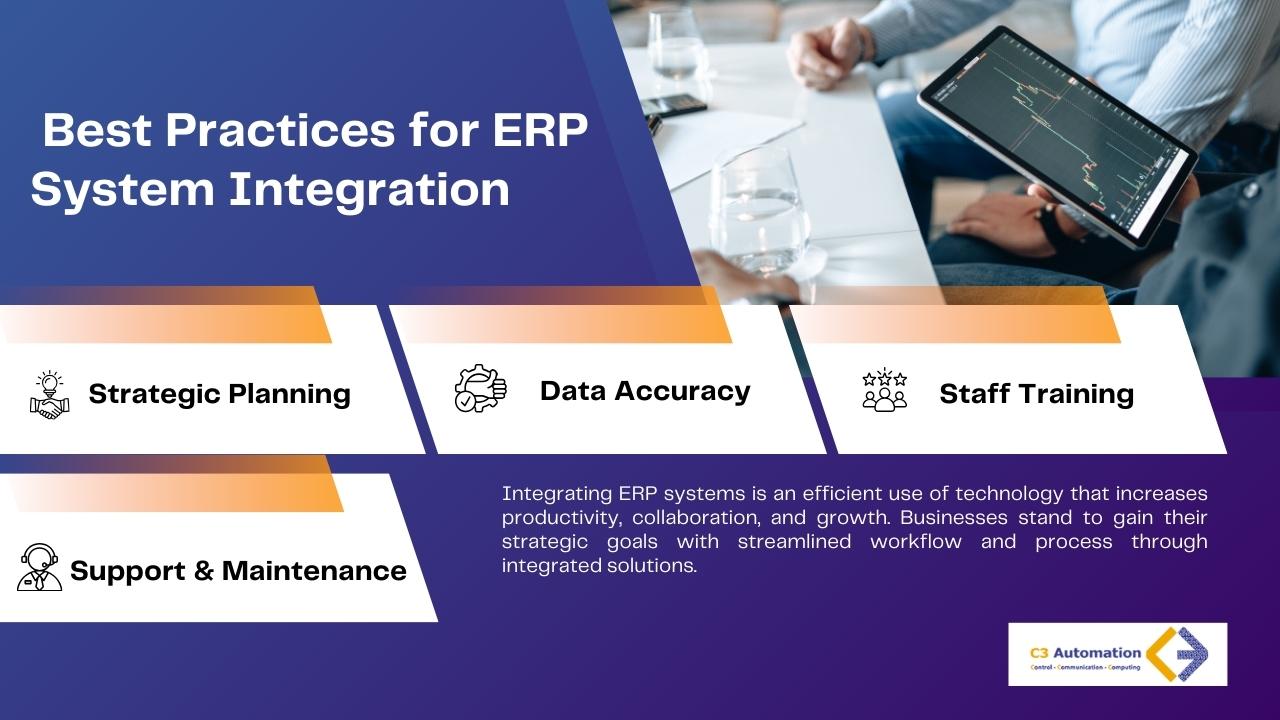
- Strategic Planning: Planning should be precise to ensure ERP integration achieves business goals, as set at the beginning, and avoid interruptions. Using a well-defined integration strategy makes certain that no oversights are made throughout the integration process. Everything is aligned.
- Data Accuracy: Building a clean and accurate dataset is fundamental for the efficient functioning of the ERP system. Data cleansing processes remove inaccuracies, errors, and gaps, which ensures a smooth transition.
- Staff Training: Providing appropriate training enhances the adoption and use of the new system by staff. Empowering employees through training allows them to make full use of the ERP system’s capabilities and functionalities.
- Support & Maintenance: Taking a hands-on approach through systematic checks enables systems to be kept functional throughout their lifecycle. Assisting system users and carrying out regular checks helps the system achieve its required state/OEE.
Common Challenges in ERP System Integration and How to Overcome Them
1. Data Migration
The process of moving data from established systems can prove demanding. However, with Automation’s guidance, it is made simple without jeopardizing the data’s pristine state. Their approach minimizes risks associated with data loss or corruption.
2. System Compatibility
Combining different software applications and older systems may create challenges. However, modern methods to guarantee compatibility of all systems. Their approaches close the gaps present in various technologies.
3. User Resistance
Willingness to adopt new technology often requires a soft approach to highlight the positive outcome of the change. Focuses on change management to smooth the transition.
Emerging Trends in ERP System Integration
1. Cloud-based ERP
Business processes can be controlled easily as a result of the migration to cloud-based ERP systems. These solutions give the business flexibility to scale up or down without spending significantly on infrastructure. Cloud-based ERP is also cheaper and can be accessed remotely.
2. AI and Automation
Artificial intelligence(AI), along with automation, offers new capabilities in ERP systems by improving decision-making and predictive analysis accuracy. With advanced insights provided by AI, businesses can foresee changes and streamline activities accordingly.
3. ERP For SMEs
Now, small and medium businesses can integrate all their operations into one ERP system. This levels the competition with large corporations. Small and medium businesses can now compete with bigger organizations because these tailored integration solutions are designed to grow with the business.
Conclusion: Start Your ERP Integration Journey
ERP system integration is a strategic investment that drives operational efficiency, data accuracy, and business agility. By unifying critical processes into a single platform, companies can achieve faster decision-making, better collaboration, and sustainable growth.
FAQ
1. What is ERP system integration?
ERP system integration, or integration of Enterprise Resource Planning (ERP) systems, is the linking of all business processes like finance, human resources, buying and selling, and inventory management into a single, integrated system. It enables optimal business performance through improved data flow, better decision making, and smooth organizational operations.
2. Why is ERP system integration important for my business?
This is important because it integrates data as the main business information is readily available, which ensures the business operates efficiently and with accuracy. Automated workflows make it possible to reduce manual errors and improve productivity, resource expenditure, and resource allocation while facilitating enhanced growth.
3. How long does it take to implement an ERP system?
Integration of ERP systems depends on the intricate details of the system, the customization needed, and the organization’s size. Usually, the integration of an ERP system takes anywhere from three to twelve months for system configuration, data uploads, testing, and training.
4. What are the key benefits of ERP system integration?
The key benefits are:
- Increased productivity due to automation.
- Enhanced accuracy and speedy decisions due to a central, real-time data mechanism.
- Cost-effective due to the streamlined processes with redundancies eliminated.
- Scalability means adapting to changes in growth as your business changes. Increases customer service by optimizing order processing and sharing information.
5. When should I consider integrating an ERP system into my business? How do I know whether my business needs ERP System Integration?
The answer lies within two scenarios. Your business likely poses challenges with inefficiencies in productivity, disconnected information systems, and unmanageable reporting structures. An ERP integration could, in fact, serve as a very effective solution to these challenges in eliminating complex processes. Standing alone, ERP systems are quite beneficial for those businesses that have multiple software systems that need document and data management.