
Ethernet Port: The Backbone of Reliable Connectivity in an Wireless World

In an age of wireless hotspots, it’s easy to forget about one classic champ of Internet connectivity – the Ethernet Port. While WiFi has the freedom and luxury to connect without wires, Ethernet will ensure any network you connect to is going to run fast and securely, and reliably. If you are in a business, smart devices, and devices used for industrial practical use of a reliable Ethernet connection is still the minimum requirement for speed and usability.
What Exactly is An Ethernet Port?
This type of port is a socket or interface on a computer, industrial router, managed switches , or IoT device that allows the device to connect to a network over an Ethernet cable. This i s a physical point of junction for all the devices in the Local Area Network (LAN) to talk to and transfer data from one another.
Typically seen under the words “LAN” or “RJ-45”, ethernet have been the primary evolution of high-speed data transfer for many decades, but now we have Hive started to produce some variations this kind of port to transmit and receive highly extra high speed, better security protocols, and even a smart way to transmit power.
Ethernet vs WiFi: Which is Best for Your Network?
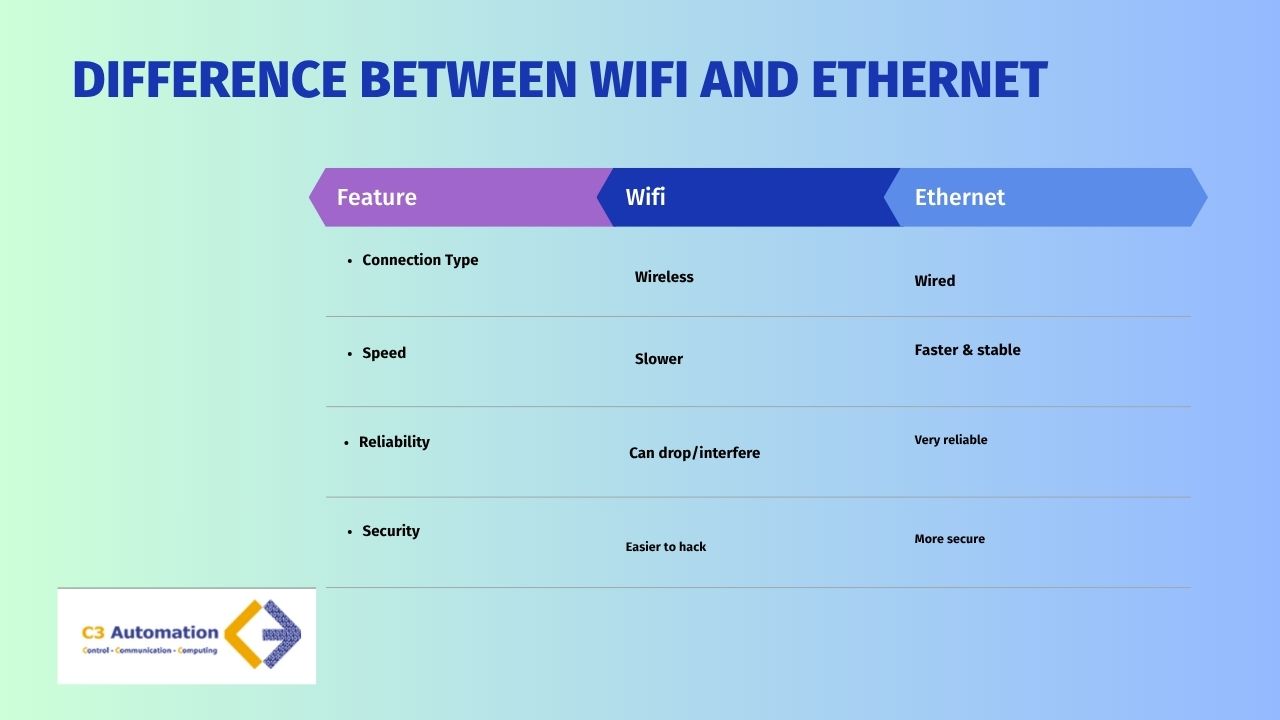
As technology continues to advance, the debate around the use of the two primary ways to connect to a network continues, ethernet and wifi. WiFi certainly provides the option of being portable, however, when you need speed or reliability which takes place much more often in applications that are bandwidth-heavy, data-dependent, and interactive, ethernet will always deliver.
Many systems can work together in mission-critical application that utilize both forms of connectivity. Both ethernet and WiFi will co-exist, however the ethernet connection will be the backbone of reliable mission-critical applications. Your C3 infrastructure will have always-on messages through ethernet (no round trip latency) without loss of performance due to interference or signal range.
Difference Between Wifi And Ethernet
Improving Connectivity By Selecting The Right Ethernet Cable
A Quality Ethernet Cable is paramount for any wired connection. C3 Automation leverages testing all of the Ethernet type of Ports we manufacture/offer to ensure that they meet the current cable standards from Cat5e to Cat8.
Types of the Ethernet Cables
- Cat5e -Good and affordable and practical with limited connections/settings up to 1 Gbps.
- Cat6 – The most popular with the best balance of speed and cost (1-10 Gbps).
- Cat6A – Ready for speed and future
- Cat7 and Cat8 – High-quality cables that will support connection speeds of 10-40 Gbps, these will be useful in complex layout or distance.
Benefits of using the right Ethernet Cable
- Reduced interference and Latency
- Increasing data transfer rates
- Increase stability and uptime
- Durability for sustainable connection
Fastest Port for Peak Performance
Speed is at the centre of networking in today’s world. C3 Automation’s Fastest Ethernet type Port offers ultra-high-speed connections for advanced industrial network security for data intensive tasks from automation to cloud computing.
Features
- Up to 40 Gbps speeds and greater.
- Low Latency for real-time data transaction
- Energy Efficient Engineering
- Backward Compatibility to previous Ethernet Standards.
- Rugged Design for Industrial Grade Performance
If your organization is engaged in IoT analytics, smart manufacturing or large cloud gateway systems, the C3 Automation ensures that you are not impaired by bottleneck connections.
Optimising Ethernet Port performance
Ethernet performance could eventually enhance most Enterprise network connections, IOT devices and intelligent control industries by providing a solid ethernet connection with optimal uptime and reliability. This port performance is optimised in following methods
* Automated diagnostic programs for preventative maintenance.
* Connection to intelligent monitoring systems.
* Firmware updates through intelligent monitoring systems to improve performance successively.
These proactive measures are low downtime and increase bandwidth so you can spend less time on networking and more time on increasing revenue!
Deploying Ethernet for IoT and Automation
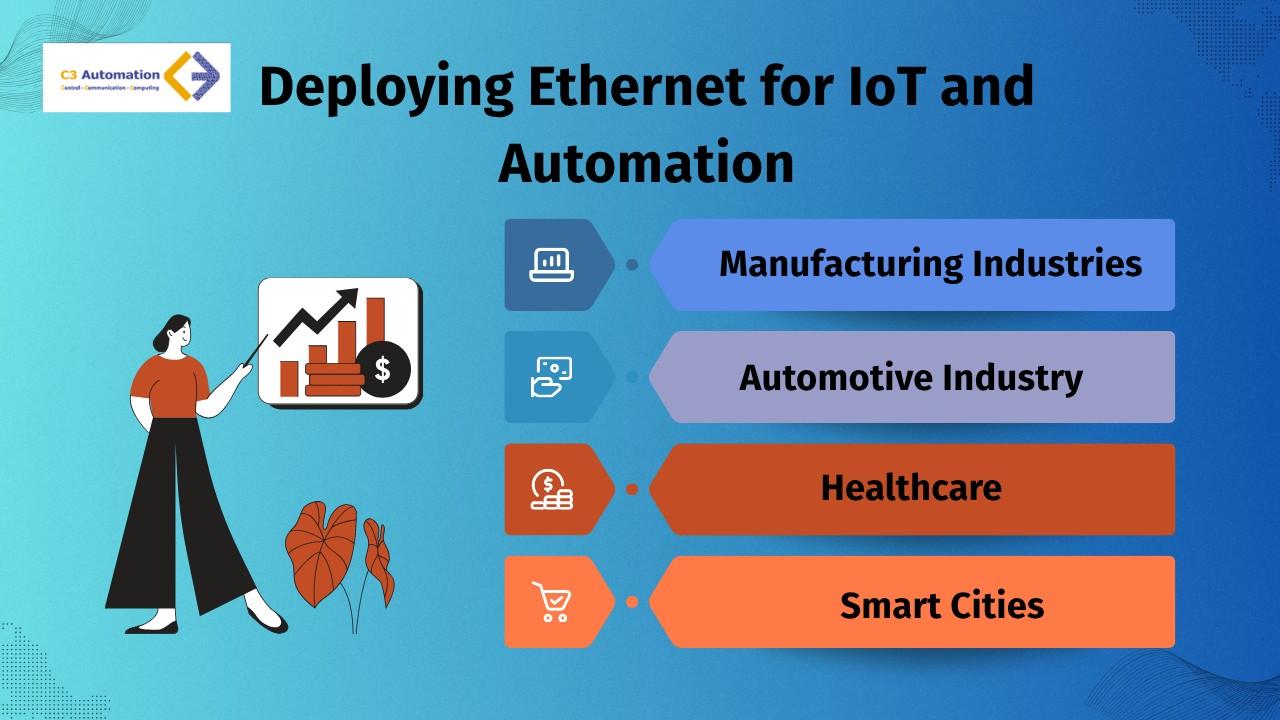
Using Ethernet Products, facilitates a first step in the global total industrial ecosystem complete-connectivity framework. This Ports displayed the strength and elasticity of powerful Connections in IoT ecosystems and automation.
- Industrial Deployment of Our Ethernet Products
- Manufacturing: Stall and robotics connectivity.
- Energy and Utilities: Trusted connectivity for remote sensors and electricity to grids.
- Healthcare: Continuous connectivity for medical devices.
- Smart Cities: Infrastructure connectivity, utilization, and sharing of public data.
- Automotive: Provides connected vehicles with ultra-high-speed announcements of the internet and diagnostics to all running processes in development and while being transported.
It enables the organization to convert an array of outdated connections, and mission-critical infrastructure into Ethernet Products, providing reliable, ultra-high-speed data via cable connection, which enables deployment and breakout of data to today’s interconnected multiplatform observational environments.
How Ethernet Ports Help with Internet of Things (IoT)
The Internet of Things (IoT) is primarily driven by wireless network connectivity. However, there are many devices that form the backbone of a complete IoT solution that rely directly on this Ports for reliable and continuous communications. When you have used a wired resource in an Ethernet connected environment, it ensure stable, consistent data flow to those devices for real time monitoring, automation and analytics to make informed decisions.
Ethernet provides reliability while Wi-Fi accommodates flexibility. Using a hybrid environment provides the reliability of fixed Ethernet Devices, while using light-weight Ethernet wireless devices is not as influenced by switching back and forth between wifi channels while communicating with ethernet devices.
CONCLUSION
This is a valuable part of our connectivity landscape, offering speed, reliability, and even security that wireless has not been able to deliver on yet. Reliable operation will always be the promise; whether we will see that in business, a data center, or a home network. Using Ethernet and WiFi, choosing the right Ethernet Cable, and using Fastest Ethernet Port, you will future proof your network and provide efficiency like you have never experienced.
This port is a valuable part of our connectivity landscape, offering speed, reliability, and even security that wireless has not been able to deliver on yet. Reliable operation will always be the promise; whether we will see that in business, a data center, or a home network. Using Ethernet and WiFi, choosing the right Ethernet Cable, and using this Fastest Port, you will future proof your network and provide efficiency like you have never experienced.
FAQ
1. What is an Ethernet port used for?
An Ethernet port is used to connect devices – you might think of a computer and router, or IoT-type systems – to wired networks to get Internet connection, which usually is fast and stable
2. Is an Ethernet connection a better connection than WiFi?
Absolutely. Logically, you can always use WiFi, but Ethernet is just better, lower latency, stable connection, and security.
3. What cable do I use for Ethernet?
For whatever normal application you have, a Cat6 cable should be fine; you would generally go to a Cat7 or Cat8 cable if you have a high performance rig that requires the fastest speeds, or shielding.
4. What is the fastest Ethernet port?
While modern companies have now started to use ports which support the 100Gbps identifier, you could articulate the use case here is applications which need the ability to move information at high speeds, plus transfer data.